Imagen

The University of Alicante celebrates the International Day of Women and Girls in Science with two research workshops
19.02.2026
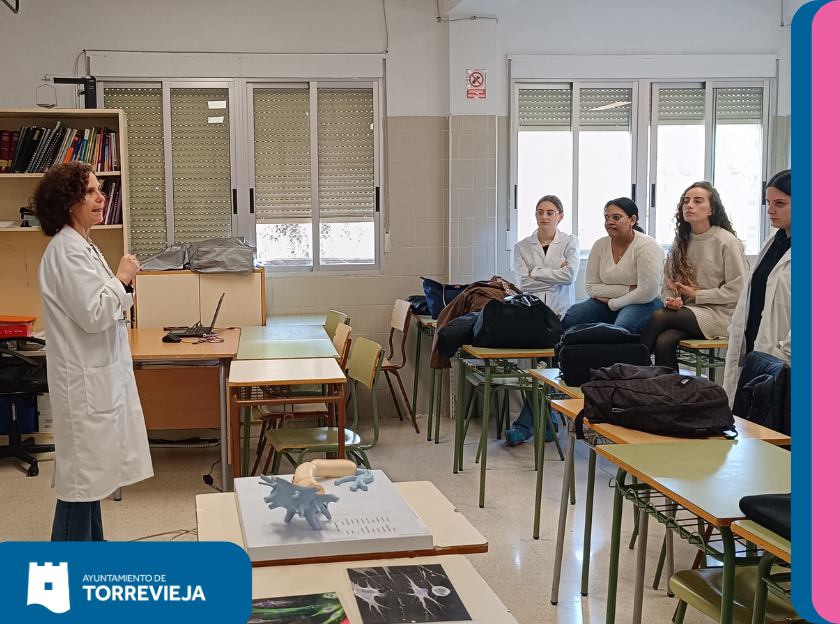
With the objectives of highlighting the role of women and girls in science, technology and innovation, as well as inspiring a professional future for young people from Torrevieja linked to science, and especially those related to STEM disciplines (science, technology, engineering and mathematics) and offering them possible paths to follow after leaving secondary school to achieve full and equal access for women to STEM areas, and thus contribute to overcoming gender barriers to achieve equality, two practical workshops were held yesterday at the IES Las Lagunas in Torrevieja.
“ Cultivation and isolation of microorganisms from salt flats, and extraction of their pigments and genetic material ” was the first course, taught by Rosa-María Martínez-Espinosa , Professor in the Department of Biochemistry and Molecular Biology and Edafol, as well as Vice-Rector for International Relations and Cooperation for Development at the University of Alicante, and Carmen Pire-Galiana , Associate Professor in the same department. Rosa and Carmen are part of the research team and project currently studying the microbial biodiversity of the La Mata and Torrevieja lagoons within the framework of the collaboration agreement between the University of Alicante and the Torrevieja City Council.
“ Isolation and Culture of Dental Pulp Cells: Applications and Uses ” was the second workshop, led by María-Luisa Molina-Gallego , a biochemistry professor at the University of Murcia. This initiative is being carried out by the University of Alicante (UA) campus in Torrevieja , in collaboration with the Torrevieja City Council's Department of Education.
The workshops were held at the IES Las Lagunas school in Torrevieja with students from the advanced vocational training program in clinical and biomedical laboratory science. They learned how to cultivate microorganisms from our salt flats in plates and liquid cultures, as well as how to harvest the microorganisms to extract their pigments and DNA. The students also learned how to extract cells from dental pulp, understanding their properties and applications in biomedical research.
This action is part of the program of activities to bring research, teaching and knowledge transfer closer to society that is being carried out in Torrevieja and is also available to the rest of the educational centers in the city.