Imagen

Torrevieja recognizes researcher Jorge Calvo Zaragoza after he receives the national award for his work in artificial intelligence applied to music.
Mayor Eduardo Dolón, along with Ricardo Recuero and Jesús Segarra, welcomes the professor from the University of Alicante, who was awarded the "María Andresa Casamayor" National Research Prize for Young People.
23.11.2026
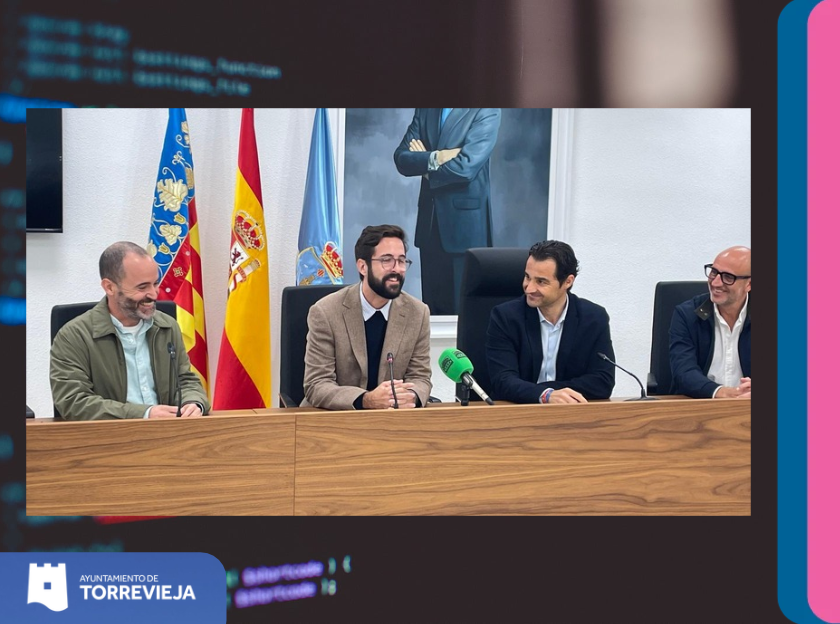
The scientist from Torrevieja dedicates the award to his city and explains how his research allows for the recovery of ancient musical scores with the help of AI and the preservation of musical heritage.
The mayor of Torrevieja, Eduardo Dolón, accompanied by the councilor for Education and Universities, Ricardo Recuero, and the director of the University of Alicante's Torrevieja campus, Jesús Segarra, received Jorge Calvo Zaragoza, a professor and researcher at the University of Alicante, on the occasion of the awarding of the "María Andresa Casamayor" National Research Prize for Young People, in the area of Mathematics and Information and Communication Technologies.
The researcher received the award from His Majesty King Felipe VI at a ceremony held on October 27th in Vitoria-Gasteiz. This distinction, granted by the Ministry of Science, Innovation and Universities, recognizes his contributions to optical music recognition using artificial intelligence techniques.
During the reception, Eduardo Dolón congratulated the award recipient and highlighted the pride Torrevieja feels in having researchers whose work achieves national and international recognition. “It is a source of pride for our city that a Torrevieja native like Jorge receives this award. His career is an example for our young people and demonstrates how far education, curiosity, and constant work can take them,” the mayor stated.
The mayor also emphasized the cultural dimension of his research: “In a city with such a close connection to music as Torrevieja, it has special significance that his work helps to recover pieces that haven't been heard for centuries. Applying artificial intelligence to the preservation of this legacy is a way of putting science at the service of our memory and future generations.”
For his part, Jorge Calvo Zaragoza expressed his gratitude for the warm welcome and his deep connection to Torrevieja, to which he dedicated the award. “I feel deeply connected to Torrevieja and I want to share this recognition with my city. Receiving this award is a tremendous honor, and being able to celebrate it here, so close to my roots, makes it even more special,” he said.
A computer engineer, professor, and chair at the University of Alicante, Calvo focuses his work on optical music recognition, a discipline that allows the identification of notes and other symbols in a musical score from its image and the transfer of that information to a digital format. His research combines computer vision and artificial intelligence to facilitate the reading and retrieval of musical documents.
One of their lines of research focuses on old musical scores written in notation systems that are no longer in common use and whose reading requires specialized knowledge. The application of these technologies facilitates their transcription and study, and opens the possibility of performing compositions that have not been heard for centuries.
“Our work consists of teaching artificial intelligence to read musical scores. There is music preserved in old documents that is difficult to interpret because of the way it is written. If we manage to read it and make it accessible, we take a fundamental step so that it can be heard again and so that this heritage is not forgotten,” explained the researcher from Torrevieja.
Jorge Calvo has also addressed his work related to the repertoire of brass bands, which is especially relevant in the Valencian Community due to its extensive network of musical societies and their presence in the life of its municipalities. Digitization and score recognition offer new possibilities for preserving, consulting, and studying these collections.
The reception has allowed the researcher to convey the recognition of his city and to bring closer a scientific work that connects computer science with music and the protection of cultural heritage.