Imagen

The City Council presents a comprehensive project that welcomes migrant children from their arrival until they start school and streamlines administrative management
21.05.2026
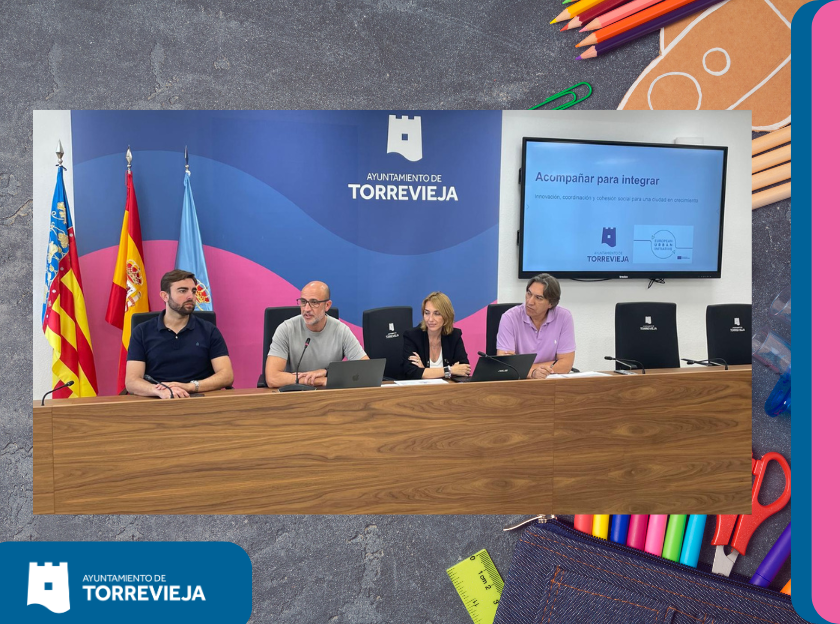
The city council is promoting a pioneering project called “Accompanying to Integrate”, which places the child at the center of the entire process, eliminating administrative barriers and accelerating access to essential public services.
The Councillor for Education and Innovation, Ricardo Recuero, together with the municipal head of the European Funds Unit, Fernando Domínguez, and the technician from the European Subsidies Department, Marga Torregrosa, presented this morning a comprehensive project by the Torrevieja City Council to welcome migrant children from their arrival until their schooling, streamlining the administrative process, called “Accompany to integrate”.
Ricardo Recuero explained that this project addresses the city's major structural challenge: ensuring that families arriving continuously have effective access to public services. It's worth noting that Torrevieja receives hundreds of children each year who need to be enrolled in school, families who are disoriented, and administrative services that are unable to meet the demand, as reflected in the diagnostic study, "on which we have been working collaboratively for months with various departments under the coordination of the European Funds Unit."
This project, which seeks two million euros in funding from the European Urban Initiative, is structured in three complementary phases that form a single pathway for the child's reception, making the child the central focus of the system. The first phase involves administrative access through a multilingual digital platform for registering the child's address before the in-person appointment. This process is streamlined with artificial intelligence to eliminate queues, reduce waiting times, and eliminate informal intermediaries.
The second phase of the program takes place during the waiting period, where a network of educational support centers is established, providing linguistic and socio-emotional assistance. This transforms the waiting period into a structured preparation phase. The third phase, focused on educational integration, involves developing balanced placement tools, classroom reception protocols, and cohesion programs, recognizing that enrollment is the beginning of integration, not its end.
Recuero explained that Torrevieja, being one of the most diverse and fastest-growing cities in Spain, requires solutions that differ from traditional approaches. “The project we are presenting not only solves a local problem but is designed to be a model transferable to other European cities facing similar challenges. If approved, Torrevieja will become a leading city in Europe for managing the reception and integration of migrant families in mid-sized cities. This comes on top of its recent recognition as a “City of Science and Innovation,” where the goal is not only to improve a service but to demonstrate that Torrevieja can lead a new way of managing urban diversity through innovation, coordination, and social cohesion.”
In his address, Fernando Domínguez discussed the impact of the massive influx of people to the municipality on local services and the need to streamline administrative procedures so they can integrate as quickly as possible and access public services. Registering as a resident is the key to accessing healthcare, education, and social services. Many of these newcomers arrive without knowing the language or the local administrative system, so it's essential to make it easier. The proposal is to create a multilingual tool that will help them understand the procedures and make them accessible, allowing them to submit all the necessary documentation as soon as possible, avoiding unnecessary requests and delays.
This project creates the necessary architecture to be scaled in two ways: in terms of the development of software that will now expedite registration but which would be extended to any other administrative procedure where there is citizen demand; and in the search for a comprehensive care service that now focuses on the minor who needs to be schooled and that would be extended to any person who needs to interact with the administration.
For her part, Marga Torregrosa, a European Funds specialist, explained that the European Urban Initiatives program finances urban innovation projects in cities facing complex challenges. It is a competitive program that will select 30 projects across Europe, and these must have significant innovation potential, demonstrable impact, and transferability. “It’s difficult to be selected because many applications are submitted, and in the previous round, only two projects came to Spain. However, we met all the requirements: there is a specific, identified problem for which an innovative solution is proposed, both administratively and socially, and it is also scalable and transferable. So we hope that Europe will see it that way and that we can obtain funding to implement it,” she explained.
Torrevieja has submitted its application to the fourth call for proposals, and if selected, the project will receive up to two million euros in European funding. This project is based on the quadruple helix model, in which the City Council, acting as coordinator, participates alongside businesses, academia, and civil society. All participants must contribute their corresponding co-financing rate, which represents 20% of their participation. This approach allows the project to be designed based on work packages, ensuring that those responsible for each package are known from the outset. The partnership arose from the specific needs of the project, and the members of the working group are currently being selected.