Imagen

Torrevieja's new urban transport system begins its implementation with a phased schedule that will culminate in 2027 with a completely renewed network
The Councillor for Transport, Antonio Vidal, and the Director of the Levante Zone of AVANZA, Luis González, present the roadmap for a service that will transform urban mobility with new lines, more frequent service, technology, better fares and a fleet of 32 low-emission buses
06.07.2026
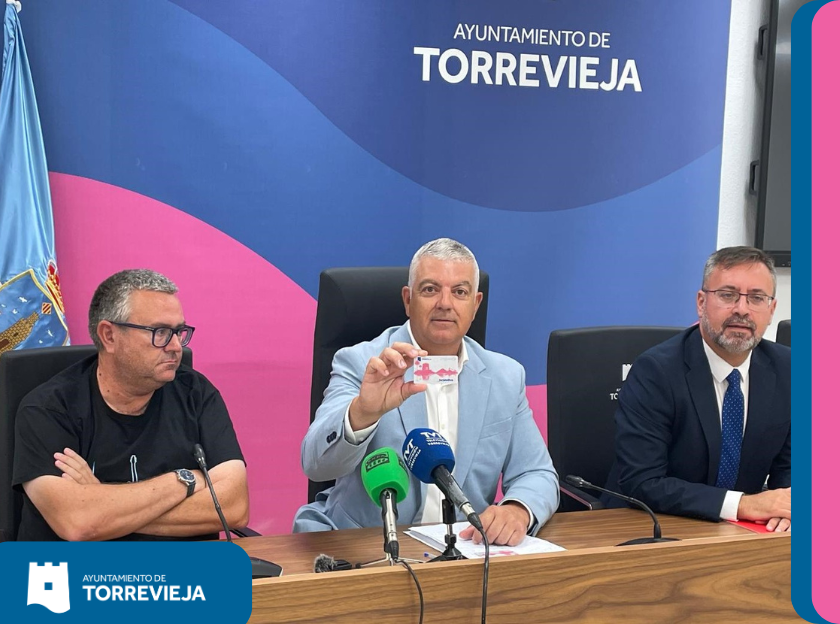
The new network of lines will begin operating on July 27th and the transformation of the service will continue over the next few months with new passes, technology, a fleet of 32 low-emission buses and modern facilities.
This morning, the Torrevieja City Council presented the implementation schedule for the new Municipal Urban Transport Service, a project representing the most significant transformation of the city's public mobility in recent decades. The service will be rolled out gradually over the coming months to ensure a smooth and efficient transition for all users. The presentation was given by the Councilor for Transport, Antonio Vidal, and the Director of the Levante Zone for AVANZA, Luis González.
The new contract will significantly expand service coverage, improve frequencies, better connect neighborhoods and residential areas, and strengthen links to the University Hospital, health centers, schools, high schools, beaches, markets, and La Mata. It will also incorporate important technological advancements and a new fleet of low-emission buses. All of this will be implemented through a three-phase rollout plan designed to allow residents to gradually integrate all the new features of the transportation model.
A GRADUAL IMPLEMENTATION TO FACILITATE USER ADAPTATION
Antonio Vidal highlighted that the City Council and AVANZA are working in a coordinated manner to bring forward as much as possible the deadlines initially planned in the contract, allowing many of the improvements to become operational several months ahead of schedule.
The councilor explained that the entire preliminary technical phase has been completed in recent weeks, including the finalization of routes, stop locations, route testing, travel time measurements, and the configuration of frequencies for the new lines. Simultaneously, staff have been hired, information campaigns have been prepared, customer service offices have been adapted, new stops have been marked, and the temporary fleet that will allow the new service to begin has been put into operation.
FIRST PHASE: JULY 2026, THE MONTH OF CHANGE
The implementation schedule will begin to materialize during this month of July, with a succession of milestones that will allow citizens to learn about and become familiar with the new service before it becomes operational.
The main dates are:
July 6: Opening of the customer service offices, where personalized information will be offered and the management of future transport tickets will begin.
July 13: Publication of the complete plans for the new network of lines.
July 20: Official release of the service frequencies for all lines.
July 24: activation of the new service website, with access via QR codes installed on bus shelters and buses.
July 24, 25 and 26: Installation of all final information on bus shelters, new bus stops, offices and municipal points.
July 27: Official start of operations of the new urban transport network with the temporary fleet of 32 buses.
During these weeks, an information campaign will also be developed using brochures, maps, social media, posters and personalized attention to facilitate the adaptation of all users to the new mobility model.
SECOND PHASE: OCTOBER 2026, THE NEW CARDS AND THE NEW FARE SYSTEM ARRIVE
The second phase of implementation will take place next October, several months ahead of the schedule initially stipulated in the contract. During this phase, the new transport cards and passes will be introduced and will coexist with the current ones until the end of 2026 to facilitate the transition between the two systems.
In addition, a traffic light priority system for buses will be implemented, a technological improvement that will reduce travel times, improve punctuality, and increase service regularity. Simultaneously, work will continue to adapt the facilities for the future incorporation of the electric fleet.
THIRD PHASE: THE TRANSFORMATION OF URBAN TRANSPORT WILL BE COMPLETED DURING 2027
The final phase of the project will take place during 2027 and will represent the culmination of the comprehensive modernization of urban transport in Torrevieja.
Between March and June 2027, the new permanent fleet of 32 low-emission buses will be progressively incorporated, of which 6 will be electric and 26 hybrid, permanently replacing the temporary fleet. The new service will practically double the current capacity, increasing from 17 available vehicles (14 in service and 3 in reserve) to a total of 32 buses, which will allow for a significant improvement in service frequency and expanded coverage.
Also, during this phase, new onboard digital systems will be implemented that will allow users to consult information, validate tickets using mobile devices, pay directly with a bank card, and have a fully digitalized transport system.
The new service facilities will also be completed, including garages, workshops, offices, an operational base, and charging infrastructure for the new electric fleet.
A TRANSPORT SYSTEM PREPARED FOR THE TORREVIEJA OF THE FUTURE
The new urban transport model will have 12 lines (9 daytime and 3 nighttime), will reduce waiting times by almost half compared to the previous service, will expand coverage to neighborhoods and urbanizations, will incorporate an on-demand transport service for certain areas and will offer a much more accessible, digital, efficient and sustainable system.
With this roadmap, the Torrevieja City Council is beginning a historic transformation of municipal public transport, designed to respond to the city's growth and offer residents and visitors a modern, comfortable, connected service adapted to current and future mobility needs.