Imagen

The UA Water Institute proposes installing floating solar panels in the quarry to reduce the cost of desalinated water and protect the agricultural lands of the Vega Baja region.
The University Headquarters of Torrevieja hosted the conference “Desalination, Energy and Agriculture” in which experts defended the essential nature of the Tagus-Segura water transfer for agriculture and the defense of desalination as a complementary resource
10.11.2026
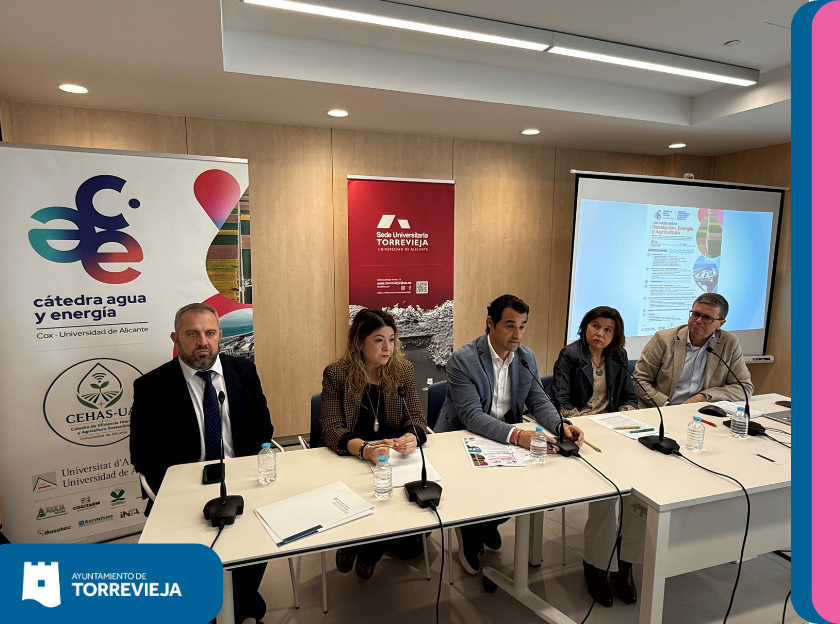
Researchers from the Water Institute have proposed using less than 10% of the surface area of the La Pedrera reservoir to produce renewable energy for the Torrevieja desalination plant, avoiding the occupation of agricultural land.
The University of Alicante's Torrevieja campus hosted the conference "Desalination, Energy, and Agriculture" yesterday, organized by the University of Alicante's Water Institute (IUACA), through the Cox Group's Water and Energy Chair and the University of Alicante's Chair of Water Efficiency and Sustainable Agriculture (CEHAS). The event, held in collaboration with the Torrevieja City Council, brought together experts in the field, as well as institutional representatives from the city council, the Region of Murcia, and the Valencian Regional Government.
During the event, which was inaugurated by the city's mayor, Eduardo Dolón, two roundtables were held on desalination and the energy challenge, and desalination and agriculture, in addition to the presentation of results from various studies carried out by the aforementioned chairs at the University of Alicante. Furthermore, researchers from the University of Alicante's Water Institute (IUACA) proposed installing a floating photovoltaic park on the La Pedrera reservoir to supply renewable energy to the Torrevieja desalination plant, reduce the production costs of desalinated water, and avoid the occupation of agricultural land of high productive, scenic, and cultural value in the Vega Baja region.
The meeting also highlighted the need to guarantee the availability of sufficient water resources at affordable prices for agriculture in southeastern Spain. In this regard, participants in the panel dedicated to desalination and agriculture agreed on the fundamental importance of the Tagus-Segura water transfer for the Vega Baja region and the need to consider desalination as a complementary, not a substitute, resource for the transferred water flows.
Experts have emphasized that the province of Alicante cannot afford to forgo any of its water resources, from the Tagus-Segura and Júcar-Vinalopó water transfers to available surface and groundwater, reclaimed water, and desalination. Combining these resources is particularly important for irrigation, as mixing desalinated water with transfer flows helps mitigate problems such as high production costs and boron content, an element that can be detrimental to certain woody crops.
LA PEDRERA, AN ALTERNATIVE FOR PRODUCING ENERGY
One of the main new developments of the day was the proposal by researchers Andrés Molina and Pablo Melgarejo, from the University of Alicante's Water Institute, to install a floating photovoltaic park in the La Pedrera reservoir. This park is intended to cover part of the energy needs of the Torrevieja desalination plant. The initiative aims to offer an alternative to projects involving the installation of large-scale solar panels on agricultural land in the Vega Baja region, which have raised concerns about their impact on the landscape, the environment, and agricultural activity.
Acuamed initially proposed building a photovoltaic plant of approximately 100 hectares in San Miguel de Salinas, a proposal that met with significant public opposition. Subsequently, a preliminary plan was drawn up to distribute these installations among various agricultural properties in the region, a solution that, according to researchers, would also have negative consequences for the traditional landscape of the Vega Baja and could involve the removal of thousands of trees. In contrast to these options, installing floating photovoltaic panels in La Pedrera would allow for the use of existing hydraulic infrastructure without transforming agricultural land of high productive and cultural value. The reservoir has an approximate surface area of 1,300 hectares, and according to the calculations presented, the solar park would occupy less than 10% of its surface area. The researchers emphasize that La Pedrera is an artificial reservoir built to store and regulate the flow of the Tagus-Segura Water Transfer, and not a natural lake or lagoon. However, its inclusion within the buffer zone of the Sierra de Escalona Natural Park necessitates an analysis of the installation's environmental and legal conditions. In this regard, Andrés Molina and Pablo Melgarejo believe that legal avenues exist to study its viability, especially given that it is a public facility linked to the energy supply of the Torrevieja desalination plant, a hydraulic project of national interest. They also point out that Article 77 bis of the consolidated text of the Water Law expressly contemplates the possibility of installing floating photovoltaic parks.
FUTURE ISSUES
The conference also addressed one of the main problems with desalination for agriculture: the high cost of water, especially in a region like Vega Baja, where the profitability of many farms depends on having sufficient water resources at competitive prices. Order TED/157/2023, of February 21, established subsidies to moderate the price of desalinated water for irrigation, setting a price of €0.327 per cubic meter for the Torrevieja desalination plant, €0.378 for Valdelentisco, €0.396 for Águilas, €0.450 for Carboneras, and €0.475 for Campo de Dalías. These figures represent savings for farmers of between €0.70 and €0.90/m³. However, this subsidy is an exception to the cost recovery principle of the Water Framework Directive, and therefore cannot be indefinite.
The order establishes a maximum subsidy period of 10 years and makes it conditional upon the construction of photovoltaic plants that structurally reduce the energy costs of the plants. The lack of implementation of this infrastructure highlights the need to find solutions that guarantee the long-term economic viability of desalinated water without imposing new environmental and territorial impacts on agricultural areas. In this context, the proposal to utilize La Pedrera aims to help resolve a dual challenge: reducing the energy cost of desalination and preserving the agricultural landscape of the Vega Baja region.
ADVANCED RESEARCH
During the meeting, the results of various research projects funded through the Cox-UA Water and Energy Chair were also presented. These projects included studies on the seasonal characterization of minerals present in brines generated during desalination and the search for solutions to improve the agricultural use of desalinated water, particularly through strategies aimed at limiting the effects of boron on crops. Another line of research focuses on energy communities as a tool to facilitate the integration of renewable energy into irrigation communities and reduce their energy costs.