Imagen

The Torrevieja City Council is promoting a psychological intervention program for competitive sports teams.
The Public Health and Sports departments are launching a pioneering training program for coaches with the aim of strengthening psychological well-being and performance in grassroots sports.
25.02.2026
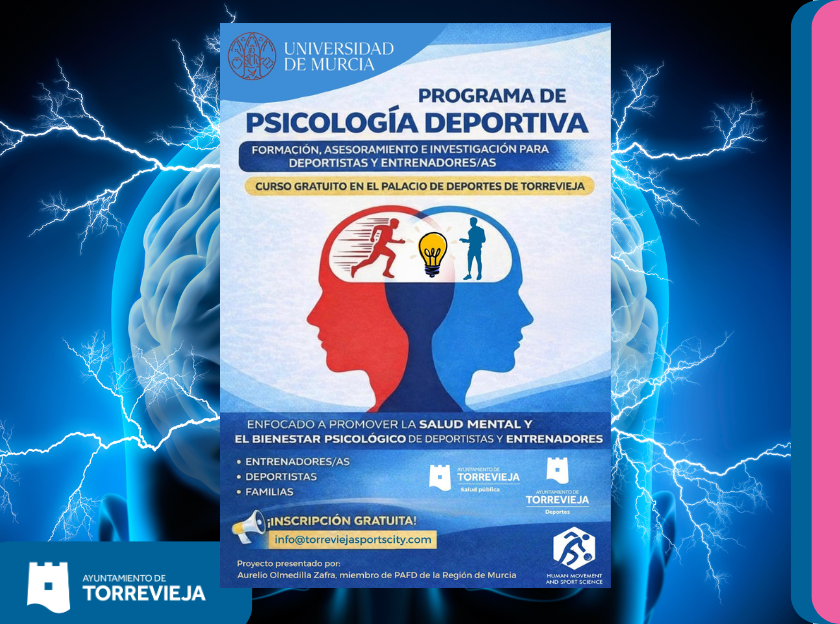
The University of Murcia will develop the program through Professor Aurelio Olmedilla Zafra, a specialist in Psychology of Physical Activity and Sport.
The Torrevieja City Council, through the departments of Public Health (Prevention and Health Promotion and Consumption) and Sports, has presented the “Psychological intervention program for competitive sports teams”, an initiative aimed at improving psychological well-being and mental health in the field of grassroots sports in the municipality.
The program was presented this morning at a press conference attended by the councilors for Public Health and Sports, Rosa Cañón and Diana Box, and Professor Aurelio Olmedilla Zafra, a tenured professor in the Department of Personality, Evaluation and Psychological Treatment at the University of Murcia.
This project stems from the identified need to work in a structured way on mental health in the sports environment, providing coaches and municipal technicians with knowledge and practical tools in sports psychology that they can apply directly in their daily work with young athletes.
The first session will be held tomorrow, Thursday, February 26, at 4:00 p.m. in the auditorium of the "Tavi y Carmona" Sports Palace, and will continue throughout the coming months. A total of 34 sports coaches have already registered for this first meeting.
In today's sporting landscape, mental health plays a crucial role in managing competitive pressure, maintaining focus, and achieving peak performance. Both elite and amateur athletes face high levels of stress, expectations, and physical demands that can negatively impact their physical and psychological well-being if not properly addressed.
RATIONALE: PSYCHOLOGICAL WELL-BEING IN GRASSROOTS SPORT
The importance of psychological well-being in grassroots athletes is widely supported by scientific evidence. Sports practice is a fundamental pillar for the holistic development of children and adolescents, and attention to their mental health is key to maximizing its benefits and ensuring their continued participation in sports.
Numerous studies, including those conducted by the World Health Organization, demonstrate that physical activity significantly reduces symptoms of depression, anxiety, and stress in young people. Especially in team sports, it has become a powerful protective factor for mental health, strengthening self-esteem and life satisfaction.
In addition, grassroots sport promotes:
Cognitive skills : improvement of thinking, learning and judgment.
Socio-emotional skills : development of self-control, social skills, interpersonal communication and sense of belonging.
Prioritizing psychological well-being during these stages is not only a matter of health, but also of long-term performance. An athlete with a healthy emotional state is better prepared to cope with the pressure and frustration inherent in competition, maintain motivation over time, reduce youth dropout rates, and improve both athletic and academic performance by enhancing concentration and memory.
The program promotes a sporting environment focused on fun, learning and personal development, avoiding excessive pressure that can lead to anxiety and dropping out.
TECHNICAL STRUCTURE OF THE PROGRAM
1. Training in Sports Psychology
Promotion of mental health and psychological well-being.
Aimed at coaches, families and sports teams.
2. Advising young athletes
3. Research into the psychological aspects of sports practice
Coaches' Program (6 sessions)
Presentation of the program and evaluation of psychological and sociodemographic variables.
How to strengthen your own motivation and that of athletes.
Strategies for the proper management of stress.
Emotional regulation in the coach and in the team.
Promoting mental health with teams, families, and managers.
Final evaluation, reflection and assessment of results.
Program for families (3 sessions)
The role of the family in the psychological well-being of children.
Management of the use of new technologies and social networks.
Balancing studies and sports practice.
Program for athletes (6 sessions)
It will take place between January and April 2026, with fortnightly sessions, working with two teams —mainly of the cadet category— proposed by the Department of Sports.
Contents:
Presentation, initial assessment and psychological preparation for the competition.
Motivation and goal setting.
Regulation of the activation level.
Attention styles and improved concentration.
Psychological techniques such as visualization.
Stress and emotion management in competition and in everyday life.
Final evaluation and reflection on the improvement achieved.